Carbohydrates (sugars) |
Key Concepts
- Carbohydrates are compounds of carbon, hydrogen and oxygen.
- General formula of carbohydrates is Cx(H2O)y, or, CxH2yOy.
- Carbohydrates are also known as sugars.
- The most common simple carbohydrates have either:
    5 carbon atoms (pentoses)
    or 6 carbon atoms (hexoses).
- A monosaccharide is made up of one sugar
    (mono means 1).
- A disaccharide is made up of two simple sugars chemically joined together
    (di means 2).
- A polysaccharide is made up of many simple sugars chemically joined together
    (poly means many).
- Monosaccharides contain the hydroxy (alcohol, OH) functional group.
- Disaccharides and polysaccharides contain both the hydroxy (alcohol, OH) functional group and an ether or glycosidic link (R-O-R') between 2 simple sugar molecules.
- 2 monosaccharides react in a condensation reaction producing a disaccharide and water.
Examples of Carbohydrates
| Carbohydrate |
Name |
Formula |
Source |
Monosaccharides (simple sugars) |
glucose |
C6H12O6 |
fruits |
| fructose |
C6H12O6 |
fruits, honey |
| galactose |
C6H12O6 |
not naturally occurring |
|
Disaccharides (double sugars) |
sucrose (glucose + fructose) |
C12H22O11 |
sugar cane, sugar beet |
| lactose (glucose + galactose) |
C12H22O11 |
milk |
| maltose (glucose + glucose) |
C12H22O11 |
germinating grain |
|
| Polysaccharides |
starch |
-(C6H10O5)-n |
energy store in plants |
| glycogen |
-(C6H10O5)-n |
energy store in animals (liver and muscles) |
| cellulose |
-(C6H10O5)-n |
plant fibre |
Structure of Monosaccharides
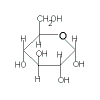
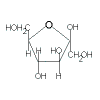
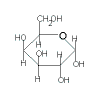
Glucose, fructose and galactose are isomers, they have the same chemical formula (C6H12O6) but different structures.
Glucose, fructose and galactose are all examples of hexoses, simple sugars containing 6 carbon atoms.
| Name |
glucose |
galactose |
fructose |
| Formula |
C6H12O6 |
C6H12O6 |
C6H12O6 |
| Structure |
 |
 |
 |
Structure of Disaccharides
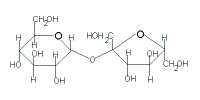
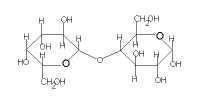
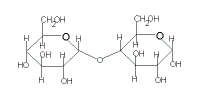
Sucrose, lactose and maltose are isomers, they have the same chemical formula, C12H22O11, but different structures.
An ether, or glycosidic, link joins 2 monosaccharides to form a disaccharide.
When two monosaccharides react in a condensation reaction the products are a disaccharide and a molecule of water.
| Name |
Formula |
Formed from |
Structure |
| sucrose |
C12H22O11 |
| glucose |
+ |
fructose |
 |
+ |
 |
|
| ---> sucrose + H2O |
 |
|
|
| lactose |
C12H22O11 |
| glucose | + | galactose |
 | + |  |
|
| ---> lactose + H2O |
 |
|
|
| maltose |
C12H22O11 |
| glucose | + | glucose |
 | + |  |
|
| ---> maltose + H2O |
 |
|
Structure of Polysaccharides
Polysaccharides are polymers of monosaccharides.
Starch, glycogen and cellulose are all polymers of glucose but they differ from each other in the number of glucose units in a chain and in the amount of branching and the position of the glycosidic or ether link.
|   |
Starch |
Glycogen |
Cellulose |
| Monomer |
glucose |
glucose |
glucose |
| Structure |
2 components: (a) amylopectin: 3000 - 6000 glucose units (branched, open structure) (b) amylose: 60 - 300 glucose units (unbranched linear structure) |
more branched than amylopectin with an open structure |
Relatively unbranched linear polymer of ~3000 glucose units. Chains linked by hydrogen bonds. |
| Solubility in water |
insoluble in cold water soluble in hot water (forms a colloid) |
soluble in cold water (forms a colloid) |
insoluble |
| Found in |
plants |
animals |
plants |
|
|
|
 |
|   |
Search this Site |
| You can search this site using a key term or a concept to find tutorials, tests, exams and learning activities (games).
|
|   |
Become an AUS-e-TUTE Member |
| AUS-e-TUTE members have access to the Test Centre which contains learning activities (games), tests and exams with worked solutions.
Find out more about AUS-e-TUTE membership.
Become an AUS-e-TUTE member.
|
|   |
Register for your Free Newsletter |
Email to
subscribe to AUS-e-TUTE's free quarterly newsletter, AUS-e-NEWS.
AUS-e-NEWS is emailed out in December, March, June, and September. |
|   |
Ask Chris, the Chemist, a Question |
| The quickest way to find the definition of a term is to ask Chris, the AUS-e-TUTE Chemist.
Chris can also send you to the relevant AUS-e-TUTE tutorial topic page.
|
|   |
Related AUS-e-TUTE Topics |
| Reducing & Non-reducing Sugars
Lipids (fats and oils)
Amino Acids
Proteins
Enzymes
DNA
Polymers and Polymerization
|
|   |
Bookmark AUS-e-TUTE |
  Bookmark this site!
|
|   |
|