DNA : deoxyribose nucleic acid |
Key Concepts
- Nucleic acids are the carriers of genetic codes in living things.
- The two principal types of nucleic acids are deoxyribose nucleic acid (or deoxyribonucleic acid, DNA) and ribose nucleic acid (or ribonucleic acid, RNA).
- DNA is a polymer.
- Individual monomer units are called nucleotides.
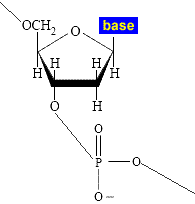
- The DNA polymer is composed of:
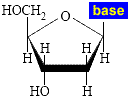
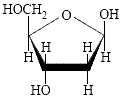
- a backbone of molecules of the sugar deoxyribose (a 5 carbon sugar)
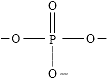
- phosphate groups linking the deoxyribose sugar molecules together in a chain
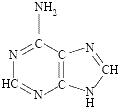
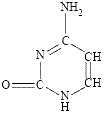
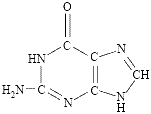
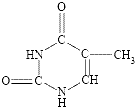
- four principal bases (2 are pyrimidines and 2 are purines):
- cytosine, a pyrimidine, abbreviated to C
- thymine, a pyrimidine, abbreviated to T
- adenine, a purine, abbreviated to A
- guanine, a purine, abbreviated to G
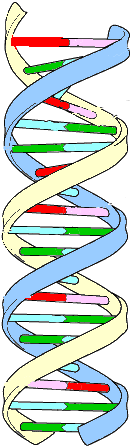
- The Watson-Crick model of DNA is that of a double helix of two long DNA molecules held together by hydrogen bonds.
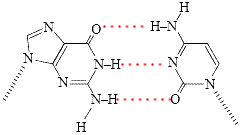
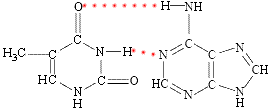
- In this "double strand" of DNA, the principal bases occur in pairs with hydrogen bonding between them:
- thymine-adenine pair formed by 2 hydrogen bonds
- cytosine-guanine pair formed by 3 hydrogen bonds
Structure of DNA
Representing a DNA Polymer Strand
 |
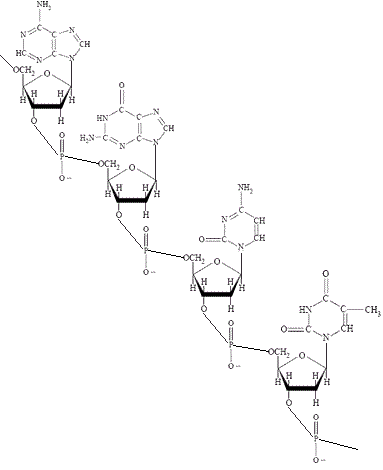
The diagram on the left shows a piece of a strand of DNA.
The sequence of bases shown from top to bottom is:
- adenine
- guanine
- cytosine
- thmine
The sequence of phosphate groups and deoxyribose sugars is always the same, only the sequence of bases changes.
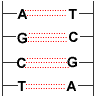
It is common to therefore represent a strand of DNA using lines to represent the sugar-phosphate backbone, and the letters A (adenine), C (cytosine), G (guanine), and T (thymine) to represent the bases.
|
Double Stranded DNA
In a double strand of DNA hydrogen bonds occur between pairs of bases:
|
|
|
 |
|   |
Search this Site |
| You can search this site using a key term or a concept to find tutorials, tests, exams and learning activities (games).
|
|   |
Become an AUS-e-TUTE Member |
| AUS-e-TUTE members have access to the Test Centre which contains learning activities (games), tests and exams with worked solutions.
Find out more about AUS-e-TUTE membership.
Become an AUS-e-TUTE member.
|
|   |
Register for your Free Newsletter |
Email to
subscribe to AUS-e-TUTE's free quarterly newsletter, AUS-e-NEWS.
AUS-e-NEWS is emailed out in December, March, June, and September. |
|   |
Ask Chris, the Chemist, a Question |
| The quickest way to find the definition of a term is to ask Chris, the AUS-e-TUTE Chemist.
Chris can also send you to the relevant AUS-e-TUTE tutorial topic page.
|
|   |
Related AUS-e-TUTE Topics |
| Carbohydrates (sugars)
Reducing & Non-reducing Sugars
Lipids (fats and oils)
Amino Acids
Proteins
Enzymes
Polymers
Intermolecular Forces
|
|   |
Bookmark AUS-e-TUTE |
  Bookmark this site!
|
|   |
|